
MASTER THE WORLD OF MODERN MARKETING
Your definitive guide to industry terms, strategies, and insights.
From fundamental concepts to advanced growth tactics, we break down complex marketing language into clear, actionable knowledge. Elevate your brand, sharpen your expertise, and make informed business decisions with absolute confidence.
Encyclopedia Contents
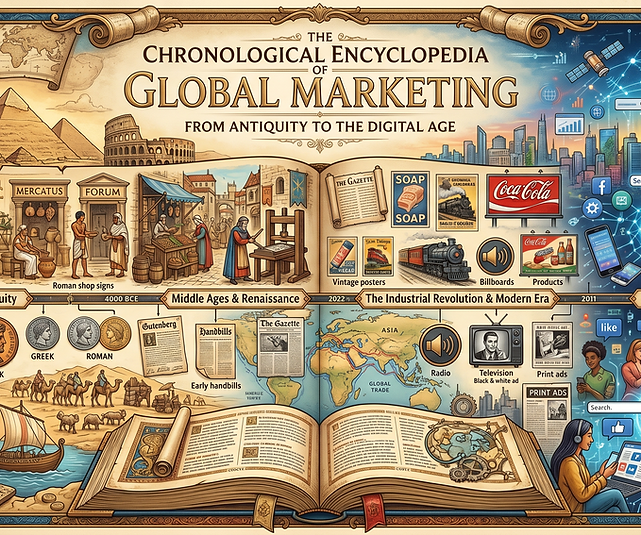
The Chronological Encyclopedia of Global Marketing: From Antiquity to the Digital Age
The evolution of marketing is a profound reflection of human civilization's transition from local subsistence to a globalized, data-driven economy. While the contemporary definition of marketing as a management process emerged in the late 19th century, the foundational practices of value exchange are as old as organized society. This encyclopedia chronicles the systematic progression of marketing thought, categorizing the major eras, philosophies, and strategic frameworks that have defined the discipline. By analyzing the chronological shifts in market orientation, it becomes evident that the focus of business has migrated from internal manufacturing efficiency toward external customer centricity and, ultimately, societal welfare.
The Pre-Industrial Foundations: The Simple Trade Era (Antiquity – 1860s)
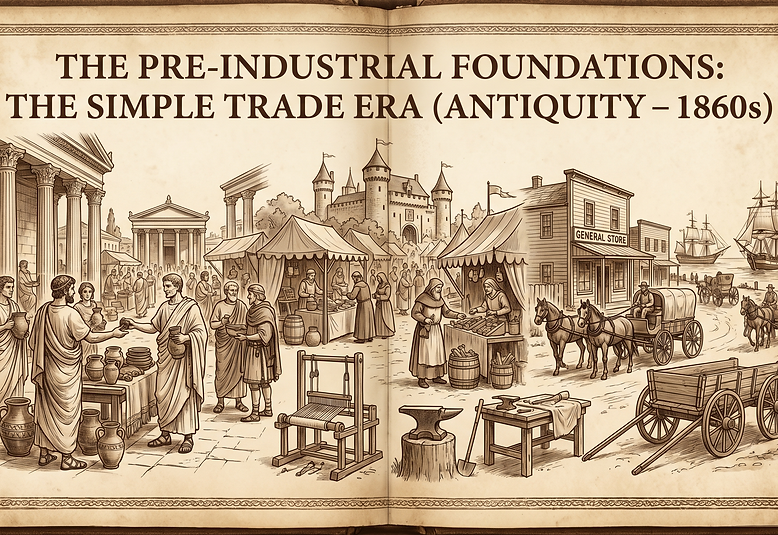
During the nascent stages of human trade, marketing was characterized by direct exchange and a reliance on local production. This period, termed the Simple Trade Era, functioned primarily through the barter system, where individuals exchanged surplus commodities to meet basic physiological needs. Early civilizations in Egypt, Greece, and Rome utilized rudimentary promotional techniques, such as shop signs and oral announcements by hired heralds, to signal the availability of goods. The Middle Ages introduced the concept of guilds to regulate trade and set standards for quality, effectively serving as an early form of brand protection.

The Dawn of Modernity: The Production Orientation Era (1860s – 1920s)
The Industrial Revolution fundamentally altered the marketing landscape by introducing steam power and mechanized mass production. As millions of workers migrated to urban centers, the expansion of industry created an abundance of manufactured goods never before experienced by households. This era was dominated by the production orientation, a philosophy predicated on the assumption that consumers prioritize product availability and affordability over specific features.
The primary objective of firms during this period was to achieve maximum production efficiency and mass distribution. By focusing on internal operations, companies could lower unit costs, making once-luxury items accessible to the growing middle class. The prevailing mindset was "if you build it, they will come," reflecting a market where demand frequently outstripped supply.
The Cognitive Blueprint: The AIDA Model (1898)

As the complexity of the marketplace increased, Elias St. Elmo Lewis developed the AIDA model to explain the psychological stages a consumer traverses when engaging with an advertisement. It remains one of the most widely applied hierarchy-of-effects models, serving as a foundational blueprint for both advertising theory and personal selling.

The Quality Standard: The Product Orientation Era (1920s – 1950s)
As competition intensified and production techniques became common knowledge, the market moved toward a product orientation. This philosophy assumes that consumers favor products that offer the most quality, performance, or innovative features. Firms began investing heavily in Research and Development (R&D) to perfect their offerings, operating under the belief that a superior product would naturally lead to market dominance.
A critical risk of this era was "Marketing Myopia," where companies fell in love with their own products and ignored shifting consumer needs. This often led to the "better-mousetrap" fallacy—building a technically superior device for which no market demand exists.
The Motivation Framework: Maslow’s Hierarchy of Needs (1943)
Abraham Maslow’s psychological framework became an essential tool for marketers seeking to understand the underlying drivers of consumer behavior. By identifying which level of the hierarchy a target audience currently occupies, firms can tailor their value propositions to resonate with specific human needs.


The Art of Persuasion: The Selling Orientation Era (1930s – 1960s)
Following the Great Depression and the saturation of many mass-market industries, firms shifted to a selling orientation. This approach is predicated on the idea that consumers and businesses will not buy enough of an organization’s products unless it undertakes aggressive selling and promotion efforts. This era saw marketing evolve into a proactive tool of persuasion, utilizing advertising and personal selling to move inventory.
The goal during this period was to sell what the company made rather than making what the market wanted. This often involved persuasive tactics aimed at clearing overcapacity or dead stock.

The Expansion Grid: The Ansoff Matrix (1957)
As businesses sought to formalize their growth strategies, Igor Ansoff introduced the Product-Market Expansion Grid. This 2x2 matrix allows management to visualize the levers they can pull to achieve growth and understand the associated levels of risk.

The Strategic Shift: The Marketing Orientation Era (1950s – 1990s)
The mid-20th century marked the most significant shift in business history: the transition from being production-led to being consumer-led. The marketing orientation holds that achieving organizational goals depends on the company’s ability to be more effective than competitors in satisfying customer needs. This era saw the "customer become king," with firms conducting extensive research before a single product was designed.

The Tactical Framework: The 4 Ps of Marketing (1960)
To provide a concrete method for implementing the marketing concept, E. Jerome McCarthy introduced the marketing mix, popularly known as the 4 Ps. This framework provides the fundamental building blocks of any marketing strategy, focusing on the variables an organization can control.

The Lifecycle Analysis: The Product Life Cycle (PLC) (1965)
Theodore Levitt formalized the PLC model to help businesses understand that products have limited lives and go through distinct stages, each requiring a different marketing mix.

The Competitive Lens: Porter’s Five Forces (1979)
Michael Porter revolutionized strategic marketing by introducing a model to assess the structural attractiveness of an industry. By analyzing five distinct competitive forces, firms can identify opportunities and threats that impact their long-term profitability.

The Service Expansion: The 7 Ps of Marketing (1981)
As the global economy shifted from manufacturing to services, Booms and Bitner recognized that the original 4 Ps were insufficient. They introduced the extended marketing mix, adding three additional elements crucial for service-based and relationship-oriented businesses.

The Precision Strategy: The STP Marketing Model (1990s)
The STP framework (segmentation, targeting, and positioning) represents the pinnacle of customer-centric planning. It allows firms to move away from generic mass marketing and focus on the most commercially valuable audience segments.

The Strategic Innovation: Blue Ocean Strategy (2005)
Kim and Mauborgne introduced Blue Ocean Strategy to help firms escape cutthroat competition. Instead of fighting for a share of a shrinking profit pool in "Red Oceans," companies are encouraged to create new market spaces that make competition irrelevant.
The Integrated Ecosystem: The PESO Model (2014)
The PESO model was developed to unify the fragmented digital and traditional media landscapes. It provides a blueprint for integrated communications, ensuring that paid, earned, shared, and owned media reinforce one another to build brand authority.


The Digital Frontier: Search Engine Optimization (SEO)
Since the birth of search engines in 1995, SEO has become the bedrock of digital discoverability. It focuses on making websites relevant, accessible, and user-friendly to earn high rankings in organic results.

The Future of Marketing: AI and Societal Values (2026+)
As marketing enters 2026, the industry is defined by hyper-personalization through artificial intelligence and a renewed focus on ethical sustainability. The societal marketing orientation, which balances consumer needs with the long-term interests of society, has become the dominant philosophy for modern brands.
01
The Simple Trade Era (Pre-Industrial Revolution)
1.1 Era Definition and Economic Context
The Simple Trade Era encompasses the vast stretch of human history prior to the industrial mechanization of the mid-19th century. This period was defined by a subsistence economy where the primary focus was on the exploration and trade of resources rather than the manufacturing of consumer goods. Economic activities were largely localized, and the concept of "marketing" in a professional capacity was nonexistent.
In this pre-industrial landscape, commodities were handmade and in limited supply. The majority of the population operated within a closed economic loop, producing their own basic necessities such as food and clothing. When surpluses occurred, they were exchanged through the barter system, a direct trade mechanism devoid of standardized currency. Marketing was fundamentally a physical act: bringing goods to a central market town to make them available. The "marketer" was the producer—the farmer, the blacksmith, or the artisan—and their "strategy" was presence.
1.2 The Mechanics of the Barter System
The visual model of the barter system is typically depicted as a bilateral, circular flow between two distinct entities, often labeled "Producer A" (e.g., a farmer) and "Producer B" (e.g., a blacksmith).
-
The Flow: Two direct arrows connect the participants. One arrow represents the flow of "Goods X" (e.g., Wheat) from A to B, while the opposing arrow represents "Goods Y" (e.g., Tools) from B to A.
-
The Friction: Unlike modern diagrams that include a central medium (currency), this model highlights the friction of direct negotiation. Text annotations often emphasize the "negotiation of relative value," indicating that the exchange rate (e.g., how much wheat equals one hammer) was subjective and renegotiated with every interaction.
1.3 Early Branding: The Roman Blacksmith and Pottery Marks
While formal marketing theory was absent, the functional roots of branding emerged during this era as a mechanism for accountability and quality signaling.
-
Roman Blacksmiths: In the Roman Empire, sword-makers and blacksmiths stamped distinctive symbols or marks onto their blades. This served a dual purpose: initially, it was a method for tracking production output to calculate wages for laborers. However, it evolved into a mark of quality assurance for the buyer, differentiating superior craftsmanship from inferior substitutes.
-
Pottery Marks: Similar practices were observed in ancient Egypt, Greece, and China, where potters marked their vessels. These marks allowed buyers to trace the origin of the goods, establishing the earliest form of "brand reputation" that could travel beyond the immediate geographic location of the producer.
1.4 Analytical Assessment: Simple Trade Era
02
The Production Era (1860s – 1920s)
2.1 Era Definition and Industrial Transformation
The Production Era was catalyzed by the Industrial Revolution, a period of profound technological change that introduced steam power, mechanization, and factory systems to the Western world. This era is chronologically situated between the 1860s and the 1920s. The defining economic characteristic of this period was that demand exceeded supply.
Consumers, many of whom had recently moved to cities from agrarian settings, had a high demand for manufactured goods that were previously unavailable or too expensive. Consequently, the primary business challenge was not selling the product but producing enough of it to meet the insatiable market appetite. The prevailing business philosophy was the production concept, which posited that consumers favor products that are available and highly affordable.
2.2 The Philosophy of Efficiency: "Build It and They Will Come"
During this era, marketing was essentially a function of production. There was no distinct "marketing department"; instead, activities related to distribution and sales were subordinate to the engineering and manufacturing departments. The strategic focus was inward, concentrating on production efficiency, cost reduction, and mass distribution. The assumption was that a good product with a low price would sell itself without the need for persuasion or segmentation.
2.3 Case Study: Ford Motor Company and the Assembly Line
Henry Ford stands as the archetype of the production era. His implementation of the moving assembly line revolutionized manufacturing, allowing the Model T to be produced at a fraction of the cost of hand-assembled vehicles.
-
The Strategy: Ford's strategy was pure production orientation. He focused on standardizing the product to maximize efficiency.
-
The Quote: Ford famously declared, "Any customer can have a car painted any color that he wants, so long as it is black." This statement encapsulates the era's mindset: variety is an enemy of efficiency. Black paint dried the fastest, so black paint was used. The consumer's desire for aesthetic variety was secondary to the manufacturer's need for speed and low cost.
-
The Result: For a time, this strategy was incredibly successful because the demand for automobiles was so high and the price point of the Model T was so accessible that consumers were willing to accept the lack of choice.
2.4 Visual Framework: The Assembly Line Production Model
The visual representation of the production era model is a linear, unidirectional process flow.
-
Input: Raw materials enter the system on the left.
-
Process: The central block represents the "Assembly Line" or "Factory," emphasizing standardization and speed.
-
Output: Identical, mass-produced units (e.g., a row of identical black cars) exit to the right.
-
Market Interface: An arrow points from the factory to the market. Crucially, there is no return arrow representing consumer feedback or research. The flow is entirely "push"-based—products are pushed into the market based on manufacturing capacity rather than pulled by consumer preference.
2.5 Analytical Assessment: Production Era
03
The Sales Era (1920s – 1940s)
3.1 Era Definition and the Crisis of Surplus
By the 1920s, the efficiency of the Industrial Revolution had created a new economic reality: supply began to exceed demand. The backlog of consumer needs had been largely met, and markets were becoming saturated. This surplus was exacerbated by the Great Depression in the 1930s, which severely curtailed consumer purchasing power.
Businesses could no longer rely on products selling themselves. This shift birthed the Sales Era, a period defined by aggressive selling techniques, high-pressure persuasion, and the rise of the traveling salesman. The philosophy shifted from "Production Orientation" to "Sales Orientation," which assumed that consumers would not buy enough of the firm's products unless the firm undertook a large-scale selling and promotion effort.
3.2 The Psychology of Persuasion: The AIDA Model
As the need to persuade consumers became paramount, formal models of sales psychology were adopted. The most enduring of these is the AIDA model, historically attributed to E. St. Elmo Lewis (1898) but popularized and widely applied during the Sales Era.
3.3 Mechanism of AIDA
The AIDA model outlines the linear cognitive stages an individual traverses during the buying process, serving as a script for the salesperson's interaction with the prospect.
-
Attention (Awareness): The salesperson must first arrest the consumer's focus. In the Sales Era, this was often achieved through door-to-door interruption or loud radio advertising.
-
Interest: Once attention is secured, the seller must maintain engagement by demonstrating the product's features and relevance.
-
Desire: The seller moves the prospect from "liking" to "wanting" by appealing to emotional triggers or status.
-
Action: The final stage is the "close"—the direct request for the sale (e.g., "Sign here," "Buy now").
3.4 Visual Framework: The Purchase Funnel
The AIDA model is universally visualized as an inverted pyramid or funnel.
-
Structure: The top of the funnel is wide, representing the "Attention" stage where a large volume of prospects enters. The funnel narrows at each subsequent stage (interest, desire) as prospects drop off. The bottom tip is the narrowest point, representing the "Action" or final sale.
-
Implication: This visual metaphor implies a "numbers game"—the strategy is to pour as many people as possible into the top of the funnel to ensure a sufficient number drop out the bottom as customers. It emphasizes volume and conversion over relationship quality.
3.5 The Rise of Radio and Print Advertising
The sales era coincided with the golden age of radio and magazine advertising.
-
Radio (1922–1941): Radio provided a medium for advertisers to enter the consumer's home with audio persuasion. In 1922, the Queensboro Corporation broadcast the first radio ad, paying $50 for 10 minutes of airtime to sell apartments.
-
Print: Magazines and newspapers became vehicles for "reason-why" advertising—long-copy ads that attempted to logically argue the consumer into a purchase.
3.6 Analytical Assessment: Sales Era
04
The Marketing Department Era (1940s – 1960s)
4.1 Era Definition and Post-War Prosperity
Following World War II, the global economy experienced a boom. The Baby Boomer generation emerged with increased disposable income and a desire for a higher standard of living. This new consumer class was more educated and resistant to the aggressive, manipulative tactics of the Sales Era.
Companies began to realize that sales, advertising, and distribution could not operate in isolation. The Marketing Department era was born from the need to coordinate these disparate functions. For the first time, "marketing" became a formal organizational unit, grouping advertising, sales, and promotion under one roof to support the company's objectives.
4.2 Key Milestone: The P&G "Brand Man" Memo (1931)
Although written in 1931, the principles of Neil McElroy’s internal memo at Procter & Gamble became the operational standard during this era. McElroy, a junior executive, was frustrated that P&G's Camay soap was competing for resources against P&G's own Ivory soap.
-
The Proposal: McElroy proposed the creation of a "brand man" (now known as a "brand manager"). This individual would be responsible for a single brand as if it were a separate business, overseeing its specific advertising, sales, and product development.
-
The Impact: This shift was revolutionary. It moved the focus from "selling soap" (generic) to "building Camay" (specific brand equity). It decentralized decision-making and allowed companies to manage portfolios of competing products effectively.
4.3 The Marketing Mix: The 4Ps Framework
In 1960, E. Jerome McCarthy synthesized the tools available to these new marketing departments into the 4Ps of Marketing, a framework that remains the bedrock of marketing education.
Detailed Components of the 4Ps
-
Product: The goods or services offered to meet customer needs. This includes design, features, packaging, quality, and warranty. The goal is to create a product that provides value.
-
Price: The amount the customer is expected to pay. Strategies include skimming (high initial price), penetration (low price to gain share), or competitive pricing.
-
Place (Distribution): How the product reaches the customer. This involves retail locations, logistics, inventory management, and channel partners.
-
Promotion: The communication activities used to persuade the market. This includes advertising, public relations, sales promotions, and personal selling.
4.4 Visual Framework: The Marketing Mix Circle
The 4Ps are typically diagrammed as a target.
-
Center Bullseye: Labeled "Target Market" or "Customer."
-
Surrounding Ring: Divided into four quadrants, each labeled Product, Price, Place, and Promotion.
-
Implication: The diagram illustrates that these four elements are controllable variables that surround and serve the target customer. They are interconnected; a change in one (e.g., raising price) necessitates a change in the others (e.g., improving product quality, shifting to an exclusive place, and elevating promotion) to maintain equilibrium.